
| |
Tire Pressure Monitoring Tools
What is a tire pressure monitoring tool?
There is no common standard for the TPMS sensors with variations including frequencies, modulations, data structure, communications protocols, mechanical fitment and many other factors. When TPMS is installed and tested in the car plant by Bartec the process includes:
- The TPM sensors are attached to the wheel during the Wheel and Tire assembly process
- The wheels are attached to the vehicle. This is the first time at which the TPMS can be clearly associated with the vehicle.
- Fixed radio antennas are used to extract the unique IDs (and other data) of the TPMS, associate them with their wheel position on the car and the Engine Control Unit (ECU) can then be programmed with this data.
- The car is then run through Rolls Test where the system is tested.
|
|
 |
Similarly the car dealer needs to have a portable TPMS tool available to read the wheel sensor ID and program the car's ECU in the event of TPMS battery failure, broken sensor/valve, or other repair or replacement of wheels and sensors for custom wheels, winter tires, tire rotation etc.
A good TPMS tool should have the following features:
- The ability to audit the vehicle before the wheel is broken down - This entails using the tool to activate and read back the data from each TPMS sensor. The tool needs to know all of the different low frequency wakeup patterns to transmit to activate the sensors on each type of make/model/year combination. It will need a vehicle look up table for all of these combinations. The tool needs to establish whether each sensor is working or not. This is an important first step because the legislation dictates that the moment the wheel is broken down the responsibility for fixing the problem passes to the dealer. Many dealers have found that customers will not accept the costs for repair and may attribute any breakage to the dealer if there is no audit trail. The Bartec tools offer the capability to show the customer the audit results from the screen or to download them to a PC and print this pre-audit so that a cost can be agreed and the go ahead given before work commences. The tool should decode the signal and be able to vary its activation power level according to the TPMS fitted. To do this it will need to know all of the decode algorithms for all of the different sensors on the market. This is very important in order to avoid picking up the transmission of other TPMS sensors, key fobs etc. It is important to limit your liability for any problems which occur.
- Diagnose faults - The TPMS tool should be able to decode the transmission from the sensor and display the data. This will enable the technician to establish if the sensor has failed or is not fitted, whether the pressure port on the sensor is blocked, where the part is running at too high a temperature and other diagnostic information which might be included in the specific sensor (e.g. if there is a low battery condition on the TPMS).
- Support the replacement of TPMS sensors and the reprogramming of the car - If a sensor proves faulty or is damaged then it will need to be replaced. This requires a new sensor to be fitted and the ECU to be reprogrammed with its unique ID and its position on the vehicle. The procedures for all vehicles are illustrated in the Mitchell1 Tire Pressure Monitoring Systems Guide which shows service requirements, reset procedures, dismounting/mounting instructions, torque specifications etc for all makes/models and years. Most vehicles manufactured in North America have an in-vehicle relearn mode which enables the vehicle to relearn the TPMS IDs when the tool is used to activate the sensor. Not all vehicles may be placed into a re-learn mode (most Asian and European vehicles do not have this feature) and for these the TPMS tool must have an extra interface to the vehicle OBDII/CANbus to communicate with the vehicle engine management or Control Unit (ECU or EMU) and download the TPMS data. The Wheelrite TECH400 has this feature.
- The TPMS Tool needs to be able to turn off the TPMS warning light - The tool should ideally display the Service kit number and the replacement part number for the TPMS sensor to ensure the correct part is fitted.
- Software updateable - New TPMS variants are emerging at an ever faster pace. It is vital that the tool can be updated using a USB cable or similar via a PC with latest TPM variants and all other attributes required to continue servicing new models. Bartec get this information long before other competitors and so users of our tools always have the most up-to-date software.
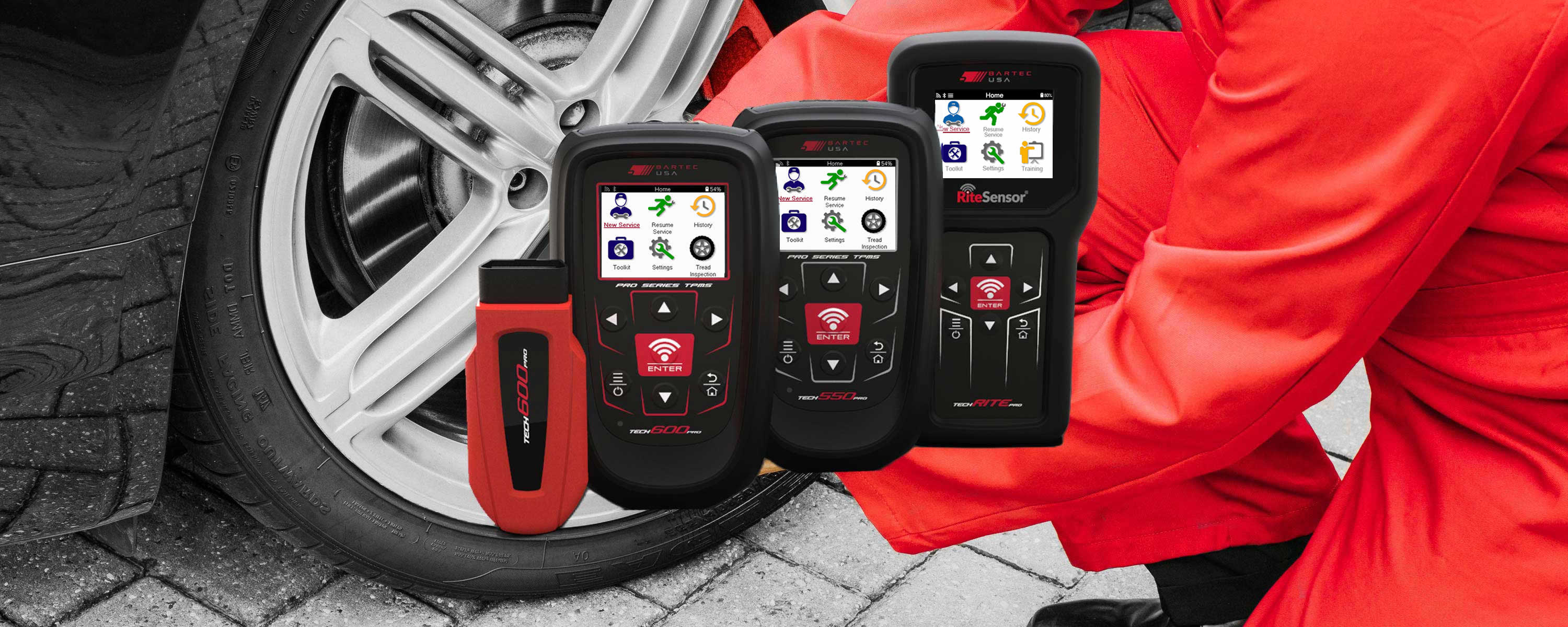
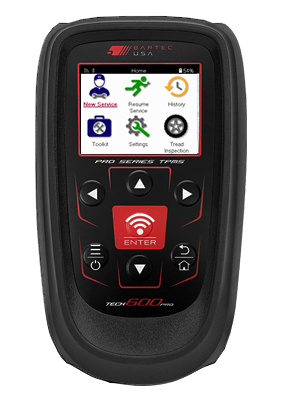
| For further detail on the Bartec range of TPMS tools see Products and/or call our technical help desk on CALL toll free (866) 407-TPMS.
Why is Bartec USA the leading authority on TPMS?
Since it installed the first plant system in 1999 Bartec have installed TPMS systems in over 70 plants worldwide and have developed a strong relationship with OE's and sensor manufacturers, whilst remaining an independent party. This enables the company's products to be more up-to-date than any other tool manufacturer. Manufacturers are changing sensor suppliers, specifications and where fitted on a regular basis but Bartec get to hear about it first. The company has worked in the Wheel and Tire companies, the car plants and with the aftermarket so understands the full range of requirements and many of the features of individual make and models. Most of all we understand the technology. Our technical help desk is there for the users of our tools to get advice on a daily basis. No other supplier offers such vital and quality resource in this area. The company offers regular training courses on TPMS tools and has training materials available for you to purchase when you are setting out on the TPMS road. For further detail on the Bartec technical support and training call our technical help desk on CALL toll free (866) 407-TPMS
|
|
 |
|
|