
TPMS Tools From Bartec USA
Home Page Bartec USA LLC Contact Details TPMS News TPMS Tools Log In Bartec Distributors
 

Bartec USA LLC
44231 Phoenix Drive
Sterling Heights
Michigan 48314
USA
Tel: (866) 407 TPMS
Fax: (586) 323 3801
Web: www.bartecusa.com
E@: sales@bartecusa.com


TPMS PRODUCTS

Wheelrite TECH400
Wheelrite TECH300 Plus
Wheelrite TECH300
Bartec Trackside
Wheelrite Journeyman
BXR Series
Mitchell1 TPMS Guide
TPMS Tool Inquiries

TPMS TUTORIALS

Introduction to TPMS
Video of TECH400
Video of TECH300 Plus
Video of TECH300

TPMS

TPMS Dealer Tools
TPMS End User Tools
TPMS Replacement
TPMS News
TPMS ROI Calculator
TPMS Legislation

TPMS SUPPORT

TPMS Tool Training
TPMS Tool Replacement
TPMS Tool Repairs
TPMS Tool Upgrades

TIRE PRESSURE MONITORING SYSTEMS

Tire Pressure Monitor
Tire Pressure Monitoring Tools
Tire Pressure Sensors

CUSTOMER SUPPORT
LOG IN

TPMS Log In
TPMS Create a New account


Tire Pressure Sensors

What is a Tire Pressure Sensor?

Direct tire sensors which transmit real time tire pressure information to the driver of the vehicle either via either a dashboard display or a warning light. The sensors are physical pressure and temperature transducers which are attached to the back of the valve stem or are in a form which is banded to the wheel. The sensors are manufactured by international companies such as Schrader, Siemens, TRW, Pacific, Lear, Beru and others. There is no common technical standard for the sensors and the OE's and suppliers have generated a multitude of sensor designs.

The sensors transmit data such as their unique sensor ID, pressure, temperature and battery status (where applicable) and other diagnostic information. This data is sent to the Engine Control Unit (ECU) or specific receiver on the vehicle. Those vehicles which have graphical displays of the sensor positions can then identify which wheel position has a problem. The typical variations in sensor technologies include:

  Tire Pressure Sensors
  • Low Frequency (LF) activation using continuous wave
  • Modulated Wave (MW) 125kHz
  • Modulated Wave (MW) 309MHz transmissions

Also some sensors require a forced change in pressure to activate. There are significant variation in activation power levels and tolerances. Most sensors have different modes for test, plant use, transport/storage, drive etc. These are activated using different datagram patterns. The activation of the sensor prompts a UHF response which may have the following variations:

  • Frequency: 315MHz, 433MHz, 434MHz etc
  • Modulations: ASK, FSK etc
  • Communications protocols: Manchester, PWM, Bi-phase etc.

There can be a significant variation in the data content transmitted by the sensors from different manufacturers and for different make/model/year of vehicles.

Bartec tools have the capabilities to work with all known OE approved sensors. Our work in implementing and testing TPMS in Wheel & Tire plants and car plants worldwide supports our market leadership for the long term and ensures that the software is reliable and proven.

What is a Tire Pressure Sensor?

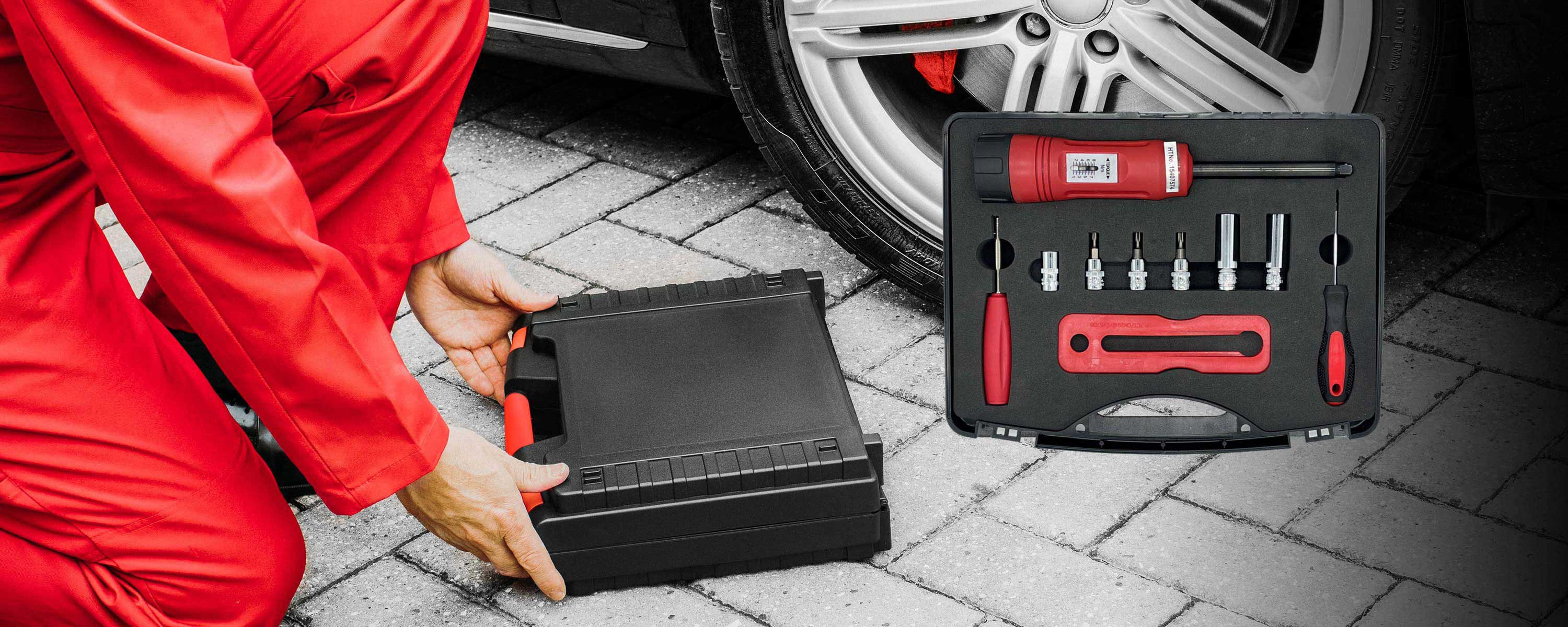
A Tire Pressure Sensor can be of the direct or indirect type according to the NHTSA legislation. In practice nearly all OE's have opted to install Direct TPMS in their new builds. A direct TPMS is a physical pressure and temperature transducer which is usually either valve stem mounted or banded to the wheel and transmits real time tire pressure information to the driver of the vehicle either via a dashboard display or a tire pressure warning light on the instrument cluster. The sensors are manufactured by international companies such as Schrader, Siemens, TRW, Pacific, Lear, Beru and others. Aftermarket sensors are now being manufactured by the aforementioned as well as by a number of Chinese and Taiwanese companies. There is no common technical standard (physical, electrical or software protocol) for the sensors and the OE's and suppliers have generated a multitude of sensor designs. The OE's have made great efforts to fit the sensors in the plants to ensure they are at the correct angle when fastening, are correctly torqued using a dynamic torque wrench to ensure that they seal and retain their seal, however, these practices have not yet been adopted in the aftermarket servicing of the TPMS. The OE's also have many electrical tests of the TPMS which have not yet been put into practice in the aftermarket to ensure that systems are properly set up before the vehicle leaves the dealer or tire shop.

  Tire Pressure Sensors

The sensors transmit data at UHF such as their unique sensor ID, pressure, temperature and battery status (where applicable) and other diagnostic information. This data is sent to the Engine Control Unit (ECU) or specific receiver on the vehicle. Those vehicles which have graphical displays of the sensor positions can then identify which wheel position has a problem.

This UHF transmission can occur at periodic intervals whilst the vehicle is in motion, immediately and continuously if an under pressure condition occurs or can be forced by a TPMS tool. The TPMS tool is required to force the sensor to transmit if it is being serviced and hence stationary.

A Tire Pressure Sensor may be replaced for a number of reasons: faulty or damaged sensor, replacement wheels or tires (winter tires, custom wheels etc) and so on.

The first step should be to use a TPMS tool to audit the vehicle and diagnose any problems such as faulty sensor battery, blocked pressure port, or simply faulty sensor. When removing the tire from the wheel the technician should be careful where the tire removal blade is positioned so as not to damage the sensor. The correct replacement part should also be ensured as the sensors from different manufacturers look alike and are easily confused.

In every sensor there is a lithium battery with an expected life of 10 years. A TPMS is estimated to be in use for 10% of the life of the vehicle. A TPMS is estimated to be in use for 10% of the life of the vehicle.

In order to preserve the battery life the many sensors on a stationary vehicle revert to a reduced activity mode. To further preserve the battery life when stored as a replacement part the TPMS is put into a storage mode (in hibernation). The TPMS should also be put into this mode when the vehicle is being shipped from Asia or Europe (or awaiting shipment or distribution). Each manufacturer has a different way to bring the TPMS out of hibernation.

In some cases the sensor has further different modes of operation that also have to be configured.

  • TPMS sensors from Schrader Electronics are supplied as replacement parts in the off mode and are simply commissioned for vehicle use. An activation tool providing a 125 KHz transmission will initialize the TPM for vehicle use.
  • TPMS sensors from Beru and Lear are supplied as replacement parts hibernated. Once pressurized over 25 PSI for a period of time they become operational.
  • TPMS sensors from Siemens VDO (now VDO Automotive AG) are supplied in a number of modes depending on the source of supplier. They can be supplied in TEST MODE and once installed on a vehicle will drive into the correct mode. Alternatively they can be supplied in SHIP MODE in which case they require activation by a 125 KHz modulated signal to put them into the correct mode.
  • TPMS sensors from TRW are supplied as replacement parts in storage mode. To bring the sensor out of storage mode and to configure it for vehicle use requires a complex modulated 125 KHz signal. This usually requires a corporate tool as used by the vehicle manufacturer.
  • TPMS sensors from Pacific are supplied hibernated and once pressurized and followed by pressure drop they become operational.
  • TPMS sensors supplied to the aftermarket as Ford replacement parts are hibernated. Once pressurized over 25 PSI for a period of time they become operational. Ford have a number of suppliers such as Lear, Siemens VDO (now VDO Automotive AG) and Schrader.


Please browse our website for more information about Bartec USA LLC and our range of TPMS Tools and our professional support for Tire Pressure Monitor Systems, then call toll free (866) 407-TPMS and speak to one of our team or e-mail us on sales@bartecusa.com.